

Lead Follow-Up Workflow: What Should Happen After Someone Submits Your Form
In short
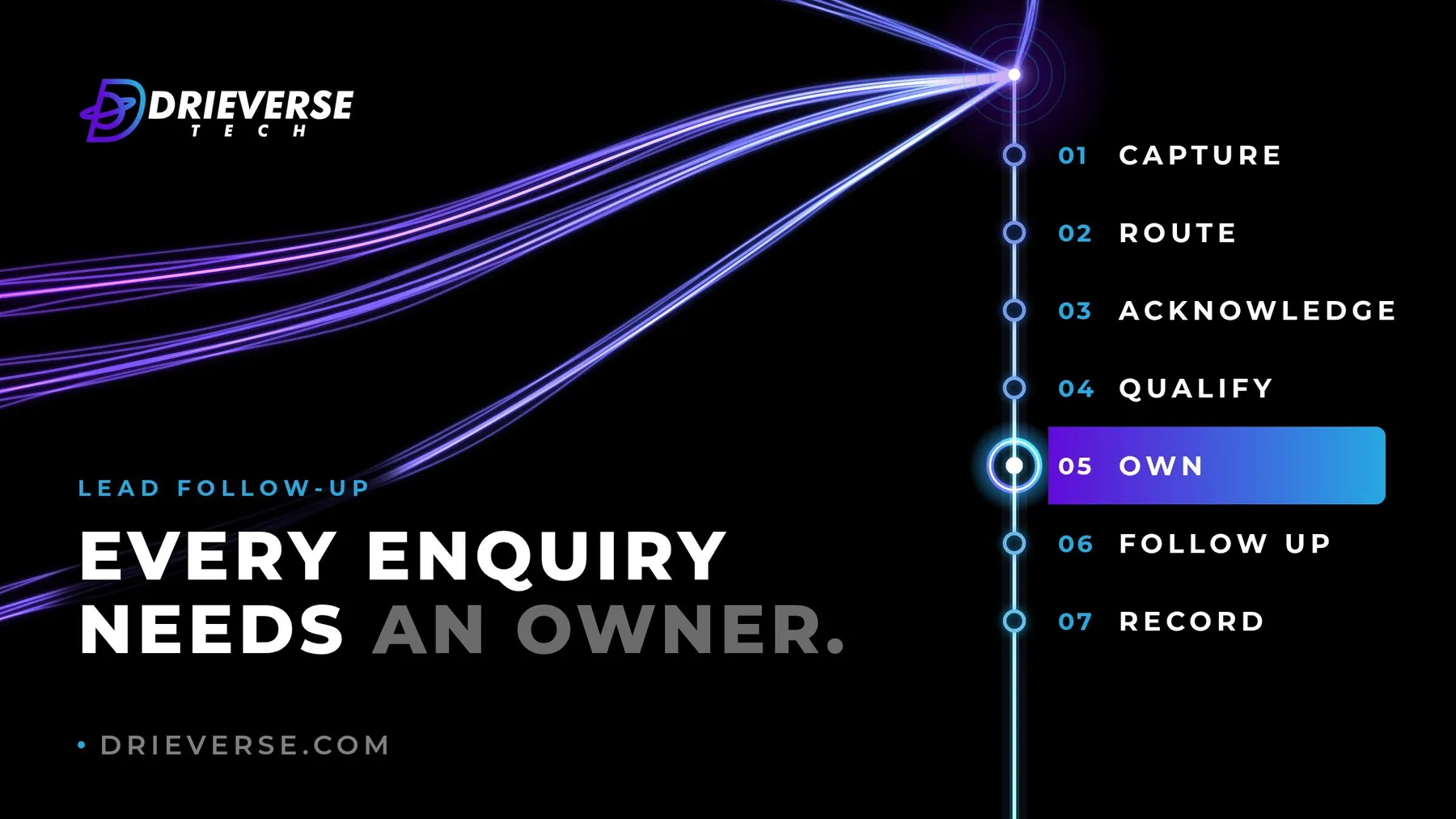
A lead follow-up workflow is the set of steps between a submitted enquiry and a sales conversation: capture every channel in one place, route by rule, acknowledge with a specific promise, qualify to decide the next step, give each enquiry one named owner, follow up on a set schedule until it closes, and record the source and outcome where sales and marketing can both see it.
Key takeaways
- Conversion does not end at form submission. An enquiry nobody picks up is a lost lead that the website report still counts as a success.
- Every enquiry needs one named owner. A shared inbox is where enquiries go to be assumed handled by someone else.
- The acknowledgment is a promise. Say what happens next and by when, and only promise what the team will actually do.
- Qualify to decide the next step, not to reject. Even a poor fit deserves a useful answer and a clear close.
- Follow up on a fixed schedule with a set number of attempts, then close the enquiry on purpose and record why.
- Record source, first response time and outcome for every enquiry, so marketing can see which channels produce customers, not just forms.
Table of contents
Most of the work on a service business website goes into getting the visitor to the submit button. We have written about what moves conversion on a service site, and all of it ends at the same moment: the form is sent, the thank-you page loads, and the analytics count a conversion.
For the person who sent it, nothing has happened yet. They have told a business they have a problem and are waiting to see who answers. What happens in the next hours and days decides whether that form becomes a customer, and on most sites that part has no design at all.
Conversion does not end at form submission. The handling of an enquiry is a workflow with seven parts, and each one can be written down, owned and checked.
What happens after the enquiry form is submitted
In many businesses the honest answer is: an email arrives in a shared inbox, several people see it, and each assumes someone else will reply. Or it goes to one person, who is on leave. Or it lands in a CRM nobody opens on Fridays.
None of these are failures of effort. They are what happens when nobody decided who does what after the form. The workflow below is that decision, made once, in advance.
Capture every enquiry in one place
Enquiries arrive through more doors than the contact form: a quote form, a direct email, a phone call, a chat widget, a message on a social profile, a referral forwarded by a colleague. If each lives in its own tool, nobody can see the full list, and nothing that follows can be applied consistently.
Bring them into one queue. The form can write straight into it; the others need a simple habit, such as logging a phone enquiry before hanging up. The queue does not need to be sophisticated. It needs to be the only place anyone looks.
Route enquiries by rule, not by whoever sees them first
Decide in advance who handles what. By service, by region, by size of request, or simply by a rota. Write the rule down, and include what happens when the person it points to is away.
Routing by rule removes the two common failures at once: the enquiry nobody picks up because everyone saw it, and the enquiry answered twice by two people with two different answers.
Acknowledge with a promise you can keep
The automatic reply is the first thing the enquirer hears from you, and most of them say nothing: thank you, we will be in touch. It is better to say what happens next and when: who will reply, roughly by when, and what they might need to have ready.
Treat that reply as a promise, and only promise what the team will actually do. "A named person will reply within one working day" is a commitment you can measure yourself against. An instant reply that promises a call within the hour, sent to a team that cannot deliver it, does more harm than a plain acknowledgment.
Qualify enquiries to decide the next step
Qualification is often treated as a filter for throwing enquiries away. It works better as a decision about what happens next: a call, a written answer, a referral elsewhere, or a polite close.
A short set of questions is enough. What is the problem, what is the timing, who decides, and is it something the business can genuinely help with? An enquiry that is not a fit still deserves a useful answer. It is a person who may come back, or send someone who is a fit.
Every enquiry needs one named owner
One person owns each enquiry from routing to close. Not a team, not a shared address, a name. Ownership moves only when it is handed over explicitly, and the handover is recorded.
The owner is the person who notices when a follow-up is due and when an enquiry has gone quiet. Without one, the queue slowly fills with enquiries that everyone believes someone else is handling. A useful check is to look at the queue for any enquiry with no owner, every working day. The list should be empty.
Follow up on a schedule, and close on purpose
Decide the follow-up pattern in advance: how many attempts, through which channel, and how far apart. Then decide what ends it. An enquiry closes when it becomes a conversation, when the enquirer declines, or when the attempts run out.
"Closed, no response" is a legitimate outcome, as long as it is recorded as one. What causes damage is the enquiry that is neither answered nor closed, still sitting open months later, so nobody can say how many leads are real.
Record every enquiry where sales and marketing both see it
For each enquiry, keep a few fields: where it came from, when it arrived, when it was first answered, who owned it, and how it ended. That is the whole CRM requirement for most service businesses, and a simple one kept faithfully beats a sophisticated one kept half the time.
Those fields answer the questions both sides of the business argue about. Marketing can see which channels produce customers rather than forms. Sales can see how long enquiries wait for a first answer. And the business gets one agreed count of leads instead of three.
Test the workflow by enquiring yourself
The simplest audit takes ten minutes. Submit your own contact form, from an address nobody recognises, with a plausible question. Then watch what happens: how long the first reply takes, whether it keeps the acknowledgment's promise, whether it was routed to the right person, and whether it appears in the record.
Do it again through a different door: the phone, the chat, a social message. The gaps usually show up on the first try.
If you are not sure what happens to an enquiry after your form is submitted, that is worth settling before spending more on bringing visitors in. Review your enquiry-to-sales workflow with us: connecting form submissions to the deals they become is part of our growth marketing work, and the first review usually starts with that test enquiry.
Frequently asked questions
A lead follow-up workflow is the agreed set of steps between a submitted enquiry and a sales conversation. It covers capturing every channel in one queue, routing by rule, acknowledging with a specific promise, qualifying to decide the next step, assigning one named owner, following up on a set schedule, and recording source and outcome in a shared system.
One named person should own each enquiry from routing until it closes, not a team or a shared inbox. Ownership moves only through an explicit, recorded handover. The owner notices when follow-ups are due and when an enquiry has gone quiet. Checking daily for enquiries with no owner catches the ones everyone assumes someone else is handling.
It should say what happens next and roughly when: who will reply, by when, and anything the enquirer should have ready. Treat it as a promise and only commit to what the team will actually do. A specific, kept commitment such as a reply within one working day builds more trust than an instant promise the team cannot meet.
Decide a fixed pattern in advance, with a set number of attempts, the channels to use and the gaps between them, rather than following up whenever someone remembers. Then close the enquiry on purpose when attempts run out and record it as closed with no response, so open enquiries in the system always reflect real, active leads.
At minimum: the source, when it arrived, when it was first answered, who owned it, and how it ended. Those few fields let marketing see which channels produce customers rather than form submissions, let sales see how long enquiries wait for a reply, and give the business one agreed count of leads.
Submit an enquiry yourself from an unfamiliar address with a realistic question, then watch how long the first reply takes, whether it keeps the acknowledgment's promise, whether it reached the right person, and whether it was recorded. Repeat through other channels such as phone, chat and social messages, because gaps often differ by channel.
Have a Growth marketing project like this in mind?
Tell us what you are trying to build. We will tell you plainly what Growth marketing work like this would take.
Get a quoteContact Us
Lahore, Pakistan · London, U.K · Austin TX, U.S · Toronto, Canada