
How Long Does It Take to Build an App? What Actually Sets the Timeline
In short
The time it takes to build an app depends on its scope, and any number given before that scope is written down is a guess. The timeline is the sum of five phases: discovery, design, build, testing and release. Each is stretched less by coding than by waiting, for decisions, integrations, content and approvals. AI tools shorten the coding, not the waiting. A dependable estimate breaks the scope into items, each with its assumptions stated.
Key takeaways
- An app timeline is only as reliable as the scope behind it. A number given before the scope is written down is a guess, however confident it sounds.
- Every build moves through discovery, design, build, testing and release. Screen count matters less than integrations, data, user roles and the number of people who must sign off.
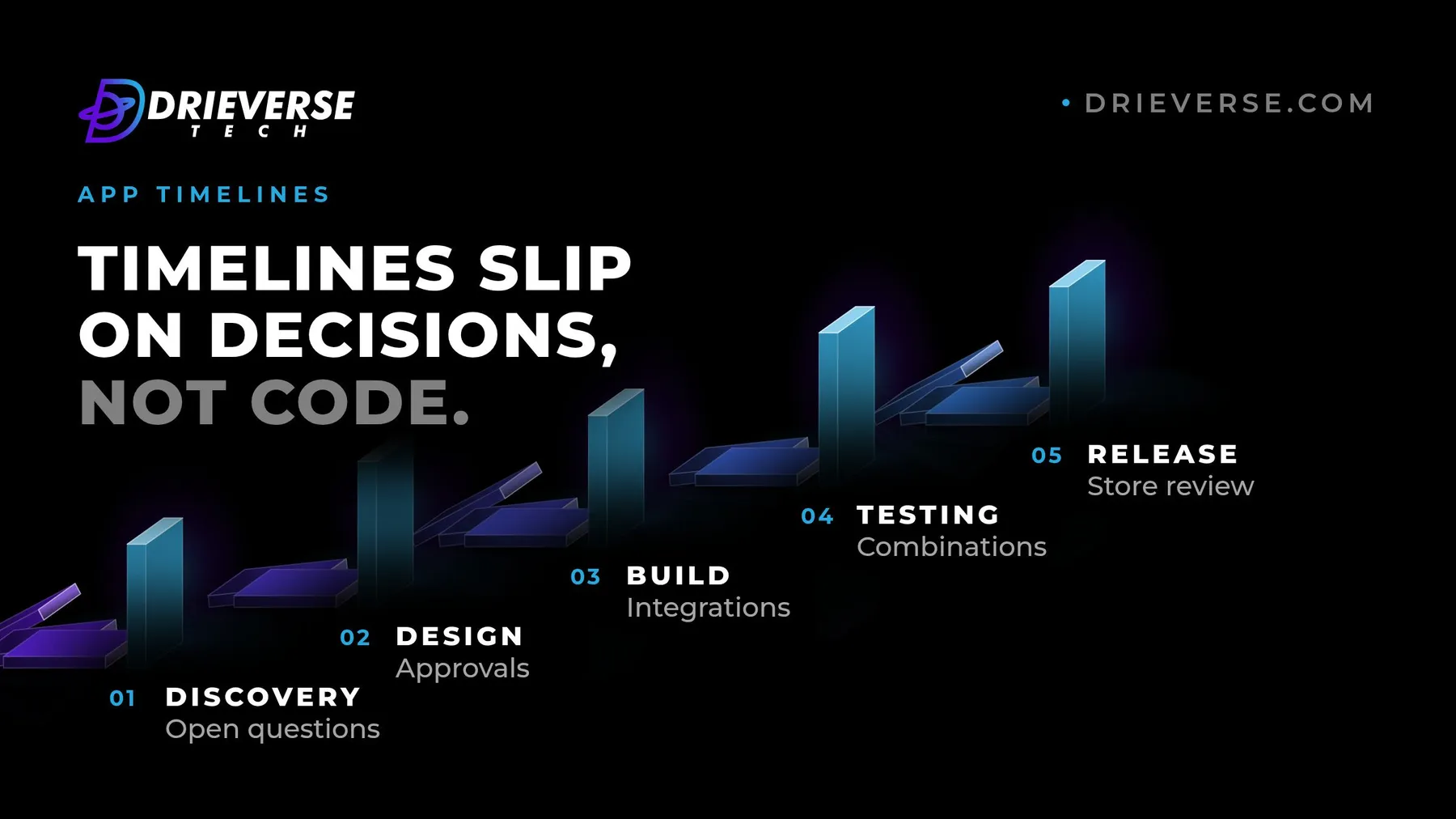
- Most app timelines slip on decisions, not code: open questions, access to other systems, missing content, and approvals queued with other teams.
- AI coding tools shorten the typing: standard code, first screens, prototypes and test scaffolding. They do not shorten deciding, waiting for access, store review, or reviewing the code they generate.
- A dependable estimate is broken into items, each with stated assumptions and a confidence level, and it narrows as discovery and design answer the open questions.
Table of contents
How long does it take to build an app? Search for it and you will mostly find tables: a simple app takes this long, a medium one that long, a complex one longer still. The tables are not so much wrong as unhelpful, because nobody can tell you which row your app belongs in until its scope is written down. A number given before that is a guess, however confident it sounds.
What can be said before scoping is what sets the timeline: the phases every app goes through, what stretches each of them, and the few things on your side that stop it slipping. Most of them have little to do with how fast anyone writes code.
Why an app timeline without a scope is a guess
An app timeline is only as reliable as the scope it was estimated from. Two apps described in the same sentence, "a booking app for our customers", can turn out to be very different projects once someone asks who books, how they pay, which calendar it has to sync with, and who handles cancellations.
Complexity tiers hide exactly those questions. "Simple" usually means few screens, but screens are rarely what takes the time. One screen that shows live availability from another company's system can outweigh ten screens of forms. The count that predicts a timeline is not features but decisions, outside systems and approvals: everything that stands between the idea and a release without being code.
The five phases of building an app, and what sets each one
Every app build moves through five phases: discovery, design, build, testing and release. They overlap in practice, but each has its own driver, and the timeline is the sum of those drivers plus the waiting between phases.
| Phase | What it produces | What sets its length |
|---|---|---|
| Discovery | A written scope, the constraints, the riskiest unknowns and what the first release leaves out | How many existing systems and open questions there are |
| Design | User flows, screens and a data model the business signs off | How many people approve, and how quickly they agree |
| Build | Working features, delivered in increments you can review | Integrations, data and the rules behind each screen, more than the screen count |
| Testing | Evidence the app works on real devices, with real data, for every type of user | The number of user roles, devices and edge cases that matter |
| Release | The app live in the stores or on the web, with monitoring in place | Store review, accounts and text that someone outside the build has to supply |
Discovery: open questions set its length
Discovery is short when the problem is well understood and the systems around it are known. It runs longer when the app has to work with something nobody has documented, or when it emerges that two departments want different things from it. That time is not lost. A question answered in discovery costs a conversation; the same question answered during the build costs rework. We have covered separately what discovery should leave you holding.
Design: the number of approvers sets the pace
Design time depends less on the number of screens than on the number of people who must agree on them. One decision maker reviewing flows inside an agreed window keeps design moving. A committee with no tiebreaker can keep the same screen in review for as long as the disagreement lasts.
Build: integrations and data, not screens
Build time follows the hard parts: integrations with other systems, moving existing data, permissions for different kinds of user, payments, offline use, and anything that has to happen in real time. A form that saves to a database is quick. A form whose answers must reach an accounting system, respect who is allowed to see them and survive a dropped connection is several pieces of work that happen to share a screen.
Testing: the combinations that have to work
Testing grows with the number of combinations that have to work: each user role, each device and operating system version you support, each state the data can be in. It is also the phase most often squeezed when earlier phases run late, which is how problems that testing would have caught end up reaching users instead.
Release: the steps outside your control
Release has more steps outside your control than any other phase. Apple reviews every App Store submission and warns that incomplete ones, such as an app behind a login with no demo account provided, may be delayed or may not pass (Apple, App Review). On Google Play, a personal developer account created after 13 November 2023 must run a closed test with at least 12 testers, opted in continuously for at least 14 days, before it can apply for production access (Google Play Console Help). Store listings, a privacy policy, a support link and screenshots all have to exist before submission, and someone has to write them.
Most app timelines slip on decisions, not code
When an app timeline slips, the cause is usually something the build was waiting for, not slow engineering. Four kinds of waiting come up again and again, and each one can be planned for.
- Decisions. Every open question in the scope becomes a pause later: which payment provider, whether staff can edit a booking after it is confirmed, what happens to someone's data when they close their account. Name one person who can decide, and keep a list of open decisions with a date beside each.
- Integrations. Connecting to another system means waiting for things you do not control: credentials, a test environment, documentation, and a contact at the other company who replies. Ask for all of it on the first day, and test the riskiest connection before anything that depends on it.
- Content. Copy, product data, images, legal text and translations come from the business, not from the developers. An app can be finished and still unable to launch because its terms of service are with a lawyer. List every piece of content the release needs, with an owner for each.
- Approvals. Sign-off from legal, security, brand or a customer's IT team adds a queue each time. Find out early who must approve what, and how long their queue usually runs, so the review is booked rather than discovered.
None of these is an engineering problem, which is why a faster developer, or a faster tool, does little for them.
How long does it take to build an app with AI?
AI coding tools shorten the parts of building an app that are mostly typing: standard code, first versions of screens, test scaffolding, data conversions and clickable prototypes. They do not shorten the parts that are deciding, waiting or verifying, and on most business apps those are what set the timeline.
| What AI coding tools shorten | What they do not shorten |
|---|---|
| Writing standard code and screens | Deciding what the app should do |
| A working prototype to react to | Access to the systems it connects to |
| Test scaffolding and repetitive tests | Content, legal text and approvals |
| Converting data between formats | App store review |
| Explaining unfamiliar code | Reviewing generated code for security and correctness |
AI also adds work of its own. Generated code still has to be read, tested and understood by whoever will maintain it, and code that arrives faster than it can be reviewed moves the delay rather than removing it.
Used well, AI makes a prototype quick enough to build before the scope is settled, and that can shorten discovery, because people agree faster when they can click something. Treat that prototype as a brief for the build, not as its first release.
How long to build an MVP: the timeline is a scope decision
An MVP's timeline is set by what you decide to leave out, more than by how fast anyone builds it. An MVP is the smallest release that can answer the question the product exists to test, so its timeline is set the moment that question, and its boundary, is written down.
The practical move is to fix the date and let the scope flex, rather than the other way round. Choose the release date, list the features, and rank them by whether the MVP can still answer its question without each one. Everything below the line waits. Fix the feature list instead, and the date tends to move each time a small feature turns out to need an integration.
If the first version is going to a small group of users before anyone else, planning an MVP pilot sets out what to settle before the first invite, and what to prioritise once it has launched covers what comes next.
How long does it take to build a SaaS product?
A SaaS product takes longer than an app with the same visible features, because much of the work sits in parts customers never see. Each customer company needs its own accounts and isolated data, people inside it need roles and permissions, and your own team needs an admin view to support them.
The list usually goes on: team sign-up and invitations, subscription billing and invoices, plan limits, audit logs, data export, email notifications, and the monitoring and backups that keep many customers running on one system. Each item is ordinary on its own. Together they can add up to more work than the feature the product is sold on, which is why a SaaS estimate that lists only the core feature deserves a second question.
How to get a dependable app timeline estimate
A dependable app timeline estimate comes from a written scope broken into items, each estimated separately, with its assumptions stated and a level of confidence attached. A single figure for the whole project, given on a first call, is a starting point for a conversation, not a plan.
- Write down what you know. A short brief covering the users, the current process, the systems involved and what is out of scope. Our guide to writing a software project brief sets out what to include.
- Settle the unknowns that could change the plan. A short investigation of the riskiest integration or data question belongs before the estimate, not after it.
- Ask for estimates per item, with assumptions. "Assumes the booking system's API supports cancellations" tells you exactly what would move the date if it proves false.
- Expect a range that narrows. An estimate made after discovery is tighter than one made from a brief, and one made after design is tighter again. A supplier who is equally certain at every stage is not being more precise.
- Put your own dependencies on the plan. Decisions, content, access and approvals belong on the timeline with names and dates, because they are the items most likely to move it.
- Agree how changes are handled. A new request should come back with its effect on the date before anyone builds it. Our delivery process shows how we size work and flag what we cannot yet estimate.
Get a timeline for your scope by sending us what you know about the app, even if it is rough. We will come back with what is still open, the items it breaks into, and the assumptions each part of the timeline rests on. That scoping step is where our app development work begins.
Sources
- Apple Developer, App Review: Apple reviews every App Store submission, and incomplete submissions, such as an app behind a login with no demo account, may be delayed or may not pass.
- Google Play Console Help, App testing requirements for new personal developer accounts: Personal Google Play developer accounts created after 13 November 2023 must run a closed test with at least 12 testers opted in continuously for at least 14 days before applying for production access.
Frequently asked questions
It depends on the scope, which is why any figure given before the scope is written down is a guess. The timeline is the sum of discovery, design, build, testing and release, and each phase is set by specific things: open questions, the number of people approving, integrations and data, the combinations to test, and app store review. A dependable answer comes after the scope is broken into estimated items.
AI coding tools make the coding faster, especially standard code, first versions of screens, prototypes and test scaffolding. They do not speed up deciding what the app should do, getting access to other systems, writing content, approvals or app store review, and generated code still has to be reviewed by someone. On a business app, the overall timeline usually shortens far less than the coding does.
An MVP takes as long as its scope, and that scope is a decision: the smallest release that can answer the question the product exists to test. The practical approach is to fix the release date, rank features by whether the MVP can answer its question without them, and leave everything below the line for later. Fixing the feature list instead usually means the date moves.
Longer than an app with the same visible features, because a SaaS product needs parts customers rarely see: separate accounts and isolated data for each customer company, roles and permissions, subscription billing, an admin view, audit logs, notifications, monitoring and backups. Together these can outweigh the core feature, so check whether an estimate includes them before comparing it with another.
Usually because the build was waiting on something outside the code: a decision nobody had made, access to another company's system, content or legal text, or an approval queued with another team. Those dependencies are often missing from the plan entirely. Putting each one on the timeline, with an owner and a date, is what keeps a schedule honest.
It can. Apple reviews every App Store submission and warns that incomplete ones may be delayed or may not pass, for example when an app needs a login and no demo account is provided. New personal Google Play developer accounts must run a closed test with opted-in testers before applying for production access. Plan the store listing, privacy policy and test accounts as part of the release, not after it.
Have a App development project like this in mind?
Tell us what you are trying to build. We will tell you plainly what App development work like this would take.
Get a quoteContact Us
Lahore, Pakistan · London, U.K · Austin TX, U.S · Toronto, Canada