

The 90 Days After an MVP Launch: Stabilise, Learn, Then Prioritise
In short
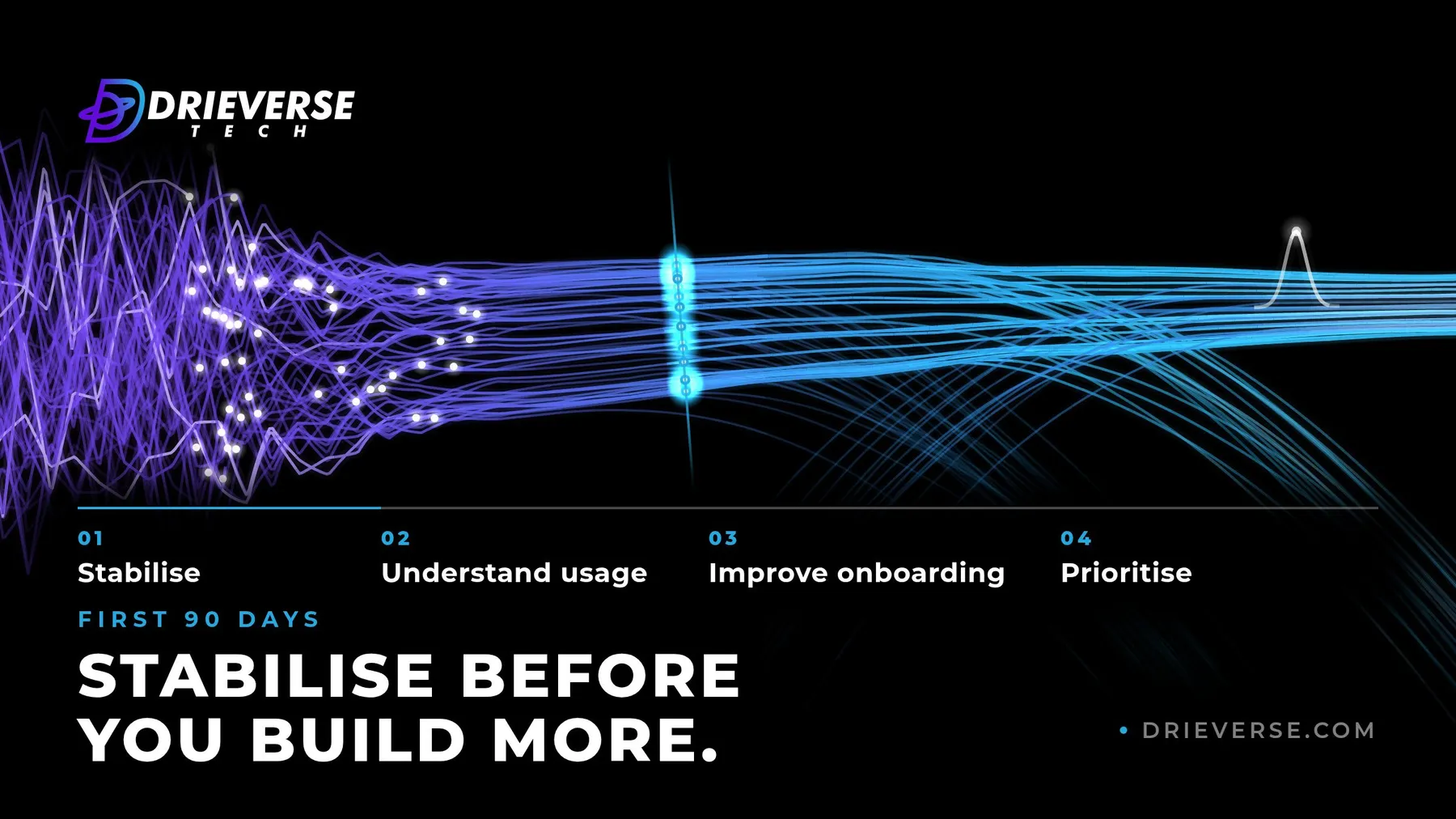
The 90 days after an MVP launch work best in order: stabilise first, fixing the failures real users hit and watching support closely; then learn how people actually use the product, measured by activation rather than sign-ups; then improve onboarding, where most early users are lost; and only then prioritise new work, from problems seen across many users rather than the loudest request.
Key takeaways
- Let real customer problems shape the roadmap, not the loudest request. A feature request is a symptom; find the problem underneath it.
- Stabilise before adding anything. The first weeks after launch belong to the failures real users hit, and a new feature built on an unstable product inherits its problems.
- Measure activation, not sign-ups: the share of new users who reach the first moment of real value, and whether they come back.
- Fix onboarding before building new features. Most early users are lost in the first session, and every later feature depends on getting them through it.
- Keep a debt list and pay down only what slows the next change. Rewriting everything at once stalls the learning the MVP was built for.
Table of contents
The MVP is live. For a few days it feels like the finish line. Then the requests start: a customer wants an export, an investor asks about a mobile app, someone on the team has a list of features cut from the first version.
The easy move is to start building whatever is asked for most loudly. It is usually the wrong one. The first 90 days after launch are the best chance a product will get to learn what it actually does for the people using it, and a roadmap written from requests skips that learning.
Let real customer problems shape the roadmap. In practice that means an order: stabilise, understand usage, improve onboarding, then prioritise.
What the first 90 days after an MVP launch are for
The first 90 days after an MVP launch are for turning a working product into an understood one. Before launch, the team knew what it built. After launch, it can find out who uses it, for what, where they get stuck, and what they come back for.
That knowledge is what makes every later decision cheaper. Features chosen from it are more likely to be used, and the ones left unbuilt are the biggest saving the period offers.
Weeks 1 to 3: stabilise before adding anything
Real users find problems that testing did not: devices nobody tried, data nobody expected, a sequence of clicks that breaks something. The first weeks belong to those failures.
Watch errors and support closely, fix what users actually hit, and hold back new features until the product behaves. A feature built on an unstable product inherits its problems, and users who meet an error in their first session rarely return to see the fix. Make sure someone is watching the alerts and the support inbox every day, not when they get a chance.
Treat support requests as the roadmap's first draft
Every support request says where the product and its users disagree. Log each one with the task the user was attempting, and sort the log into themes every week. The themes that keep growing are where the roadmap starts.
If the launch followed a pilot, this continues the habit we described in planning an MVP pilot: treating support as research, with a response time people can rely on. After launch the volume is higher and the users are strangers, which makes the log more honest, not less.
Measure activation, not sign-ups
Sign-ups measure how well the product was marketed. Activation measures whether it worked: the share of new users who reach the first moment of real value, such as a first report produced, a first booking taken or a first invoice sent.
Define that moment for your product in one sentence, then track three things: how many new users reach it, how long it takes them, and whether they return the following week. Those three numbers will say more about the product than any feature request.
Fix onboarding before building new features
Most early users who leave do so in the first session, before they have seen what the product does. Onboarding is where the product explains itself without anyone in the room, and it is usually the part the team tests least, because they set it up months ago.
Watch a few new users start from nothing. Note every hesitation. Then shorten the path to the first moment of value: fewer steps, better defaults, sample data where an empty screen would otherwise greet them. Onboarding or reliability is a fair question in the first month; after that, onboarding usually returns more than any new feature.
Keep a debt list, and pay down what slows the next change
An MVP is built with shortcuts, on purpose. That was the right call for launching, and some of those shortcuts will now get in the way.
Keep a written list of known debt: the parts that are fragile, untested, or slow to change. Then pay down only what slows the next change you actually plan to make. Rewriting everything at once stalls the product for weeks, at the point where learning from users is worth the most. Parts nobody touches can stay imperfect for a long time.
Prioritise from real customer problems, not the loudest request
A feature request is a proposed solution to a problem the customer has not described. Before adding it to the roadmap, find the problem underneath: what were they attempting, and what did they do instead?
Then look across users. A problem that appears in the support log, the activation data and several conversations is a roadmap item. A request from one large customer, however loud, is a conversation first. Building for the loudest voice is how a product drifts into something nobody else needs.
A simple sequence for the first 90 days
Timings vary by product, but the order holds.
| Weeks | Focus | What it produces |
|---|---|---|
| 1 to 3 | Stabilise | Recurring failures fixed, support answered daily |
| 4 to 6 | Understand usage | An activation definition and three numbers |
| 7 to 9 | Improve onboarding | A shorter path to the first moment of value |
| 10 to 12 | Prioritise | A roadmap built from problems seen across users |
At the end of the 90 days, the product has a clearer answer to the question it was launched to explore, and the next phase is chosen from evidence.
If your MVP has just launched, or is about to, and the roadmap is currently a list of requests, that is worth settling before the next build. Discuss the next product phase with us: it is the iterate step of our startup acceleration work.
Frequently asked questions
Work in order: stabilise first by fixing the failures real users hit and answering support daily; then measure how people use the product, especially activation; then improve onboarding, where most early users are lost; and only then prioritise new features, choosing from problems seen across many users rather than from the loudest request.
Hold back new features for the first few weeks while the product stabilises and support is answered closely. After that, spend a few weeks understanding usage and improving onboarding. A reasonable guide is to start prioritising new features in the second half of the first 90 days, based on evidence gathered in the first half.
Activation is the share of new users who reach the first moment of real value in the product, such as producing a first report or taking a first booking. It measures whether the product worked for them, unlike sign-ups, which measure how well it was marketed. Track how many reach it, how long it takes, and whether they return.
Reliability comes first in the opening weeks, because users who meet errors early rarely come back. Once the recurring failures are fixed, onboarding usually becomes the better investment, since most early users who leave do so in their first session, before they reach the moment the product was built to deliver.
Keep a written list of known debt, such as fragile, untested or slow to change parts, and pay down only what slows the next change you plan to make. Rewriting everything at once stalls the product while learning from users is most valuable. Parts nobody touches can stay imperfect for a long time.
Treat each request as a proposed solution and find the problem underneath: what they were attempting and what they did instead. Prioritise problems that appear across many users, in the support log, activation data and conversations. A single large customer's request is a conversation first, not a roadmap item.
Have a Custom software development project like this in mind?
Tell us what you are trying to build. We will tell you plainly what Custom software development work like this would take.
Get a quoteContact Us
Lahore, Pakistan · London, U.K · Austin TX, U.S · Toronto, Canada