

B2B Brand Brief: Explain the Business Before the Colour Preferences
In short
A B2B brand brief should explain the business before any visual preference: who the buyer is and what they are deciding, the problem you solve in their words, a difference a competitor could not claim, the evidence you can show, tone written as things the business does, the deliverables and where they will be used, and who signs off. Visual references belong at the end, each with the reason it was chosen.
Key takeaways
- A brand brief explains the business, not only colour preferences. A brief that is mostly adjectives and references gets back a nicer version of the same unclear company.
- Start with the buyer: who signs, who influences, what they are deciding and what they are worried about getting wrong.
- Test every claimed difference by substitution. If a competitor could put their name on the sentence, it is not a difference.
- A brand can only promise what the evidence supports. List what you can show today, and treat the gaps as work to do.
- Write the tone as things the business does. "We explain the cost before anyone asks" says more than "friendly and professional".
- Name who signs off and on what criteria before the first concept, so the work is not redirected by an opinion that arrives at the end.
Table of contents
Most brand briefs read like a mood board in sentence form. Modern, clean, bold. Something like the brand of a company twenty times the size. Blues are fine, no orange. A folder of logos someone likes.
Designers can work from that, and they will deliver what it asks for: a better looking version of the same unclear company. The visuals improve. What buyers understand about the business does not, because the brief never said what that was.
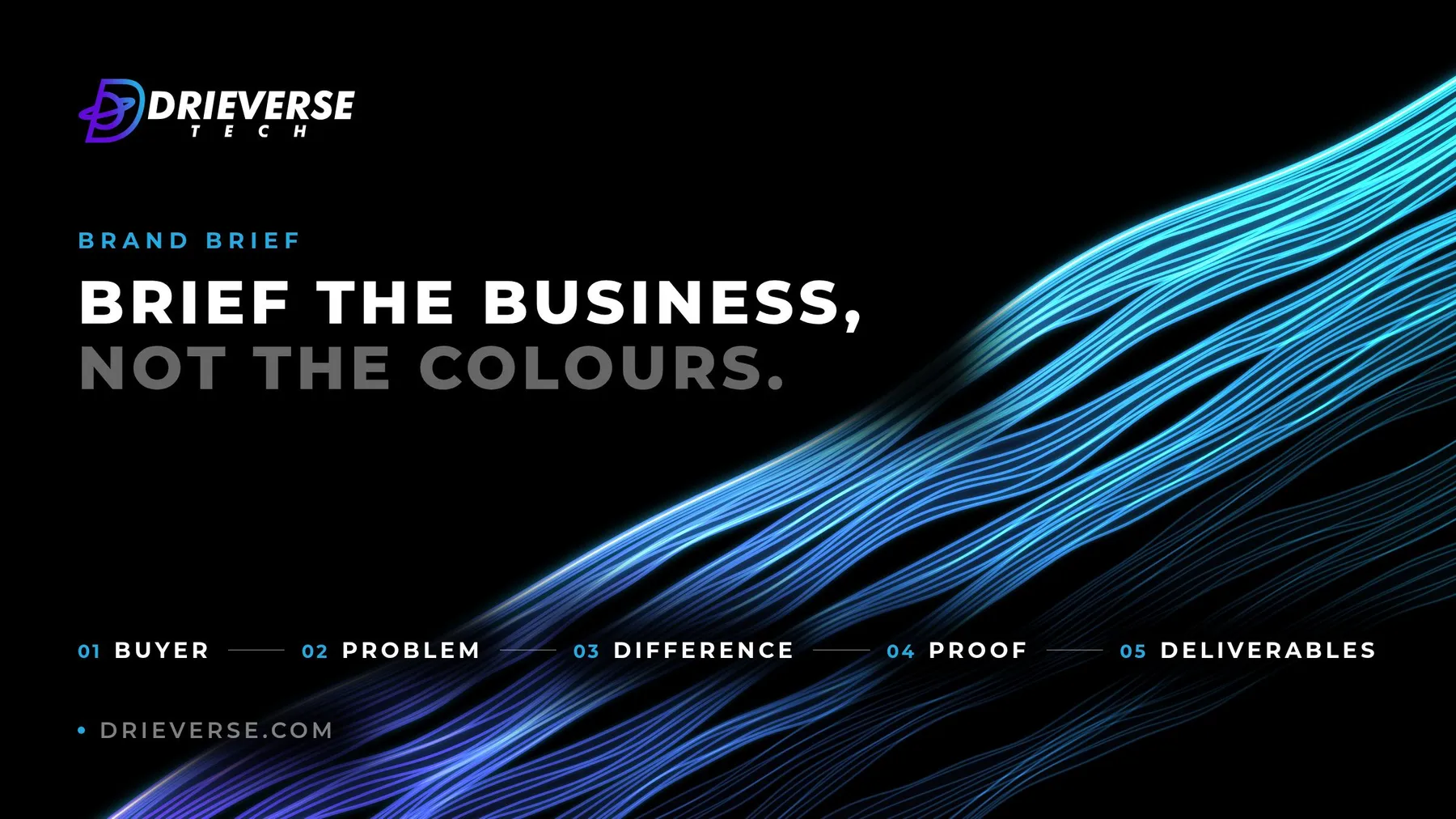
A brand brief explains the business, not only colour preferences. If you have already worked out whether you need a logo refresh or a brand refresh, this is what to write down next, in the order the work needs it: buyer, problem, difference, proof, deliverables, and then the look.
What a B2B brand brief is for
A brand brief is the document a designer or agency works from to decide what the brand has to say and to whom. In B2B, that means the brand's job is specific: help a particular buyer believe you can solve a particular problem, and make the next conversation easier.
A good brief lets someone who has never met you understand what you sell, who buys it and why they choose you, before they draw anything. Every design decision later traces back to one of those answers.
Start with the buyer, not a market segment
"SMEs in professional services" is a segment. A buyer is a person with a job to do. Describe them: who signs the contract, who influences it, what they are deciding between, and what they are worried about getting wrong.
In B2B there is often more than one reader. The operations lead who found you cares about disruption to the team. The finance director cares about risk and commitment. The brand has to work for both, and the brief should say which one matters more.
Name the problem in the buyer's words
Write down the problem you solve the way a buyer would describe it before they met you, not the way your services page names it. "Our quotes take three days because the numbers live in four spreadsheets" is a problem. "Operational efficiency" is a category.
If you have enquiry emails, sales call notes or support tickets, quote them. The phrases buyers actually use are the raw material for headlines, and a designer who has read them will make different choices.
Say what makes you different, and test it
Most claimed differences are shared by every competitor: quality, service, experience, a personal approach. Apply a simple test to each one. If a competitor could put their name on the sentence and it would still be true, it is not a difference.
What survives is usually narrower and more useful: a specialism, a way of working, a guarantee, a type of client you understand unusually well, a thing you refuse to do. Write those down, even if there are only one or two. A brand built on one real difference is stronger than one built on five generic ones.
List the evidence you can actually show
A brand can only promise what the evidence supports. So the brief should list what you can show today: case studies, results you can source, certifications, named processes, artefacts from real work, the length of client relationships.
This section is often the most revealing. If the brand is meant to say "the safe choice for regulated work" and there is nothing to show for it, that is not a design problem. It is a list of work to do, and the brief should say so. It also shapes the design itself, because a brand that leads with case studies rather than testimonials needs room for detail that a logo and a slogan do not.
Write the tone as things the business does
Every brief asks for a tone that is professional, approachable and confident. Those words do not help a writer or a designer, because every competitor would choose them too.
Describe how the business behaves instead. "We explain the cost before anyone asks." "We say when something is not a fit." "We write the way we talk on a call." Behaviour can be turned into copy and design decisions; adjectives usually cannot.
Specify the deliverables and where they will be used
List what you need at the end, and where each piece will actually be seen: the website, proposal and sales documents, social profiles, email signatures, a trade stand, signage, a product interface.
The applications drive the system. A brand that mostly lives in proposals and on a website needs strong typography and a flexible grid more than an elaborate mark. A brand that appears on vehicles or packaging needs the opposite. Without this list, the designer is guessing at the priorities.
Agree who signs off before the first concept
Name the people who approve the work, and the criteria they will judge it on, before anything is designed. Gather their input once, at the start, rather than one person at a time as concepts appear.
The common failure is late alignment: a senior voice who was not in the brief sees the work at the end and redirects it on taste. The fix is simple and slightly uncomfortable. Put that person's priorities in the brief, in writing, while they can still shape it.
Keep visual preferences, in their place
References are useful. They belong at the end of the brief, and each one needs a reason: "we like this because it feels calm and technical", "this shows how much detail buyers expect". The reason is what the designer can use; the reference on its own invites imitation.
If a brand brief is mostly visual preferences today, the sections above are the work to do before briefing anyone. Discuss positioning and design with us: it is where our brand and design work starts, and a clear brief makes the first concept far closer to right.
Frequently asked questions
A B2B brand brief should cover the buyer and what they are deciding, the problem you solve in their words, a genuine difference a competitor could not claim, the evidence you can show, tone written as things the business does, the deliverables and where they will be used, and who signs off on what criteria. Visual references come last, each with the reason it was chosen.
A brand brief explains the business: who buys, what problem it solves, what makes it different and what it can prove. A design brief turns that into a specific piece of work, such as a website or a logo, with formats and deadlines. Writing the brand brief first means every later design brief inherits the same answers instead of reinventing them.
List each difference you believe you have, then apply a substitution test: if a competitor could put their name on the sentence and it would still be true, it is not a difference. Keep what survives, even if that is only one or two points, such as a specialism, a way of working or something you refuse to do.
A brand can only promise what the business can prove, so the brief should list the case studies, sourced results, certifications and processes you can show today. Gaps between what the brand wants to say and what the evidence supports are not design problems. They are work to do before the brand claims them.
Describe how the business behaves rather than how it wants to sound. For example, "we explain the cost before anyone asks" or "we say when something is not a fit". Behaviour can be turned into copy and design decisions, while adjectives such as professional or approachable are chosen by almost every competitor.
The people who will approve the finished work should agree the brief before any design starts, and their criteria should be written into it. Gathering their input once, at the beginning, avoids the common failure where a senior stakeholder sees concepts late and redirects the work on personal taste rather than on the brief.
Have a Branding and design project like this in mind?
Tell us what you are trying to build. We will tell you plainly what Branding and design work like this would take.
Get a quoteContact Us
Lahore, Pakistan · London, U.K · Austin TX, U.S · Toronto, Canada